
THE NEW RULES OF BIOTECH M&A
Introducing the OP-MA Strategic Transactions Framework
Most executives believe acquisitions create growth.
The best acquirers know the opposite.
Great acquisitions are simply the final expression of years of strategic positioning—the visible tip of an iceberg built from scientific diligence, capital architecture, and relationship engineering.
This paper introduces the OP-MA Strategic Transactions Framework—a systematic approach to understanding why some biotech transactions create lasting value while others merely transfer ownership.
Three core propositions:
Every biotech acquisition operates on three interconnected levels. Transactions succeed only when all three are executed with equal discipline.
The most successful acquirers are not buying revenue. They are buying strategic optionality.
We are witnessing the emergence of a new discipline: transaction architecture.
“Scientific breakthroughs change medicine. Strategic transactions change industries. Capital scales both.”
Part One
The Three-Layer Transaction Model
Traditional M&A analysis focuses on price, multiples, and synergies. This is necessary but insufficient.
Indeed, the OP-MA Three-Layer Transaction Model proposes that every biotech acquisition operates on three interconnected levels. Transactions achieve durable success only when all three layers are addressed with equal rigor.
For example, the Scientific Layer asks whether the science works and if the asset is first-in-class. Conversely, the Strategic Layer examines whether the acquisition creates optionality for the future. Meanwhile, the Capital Layer determines whether the transaction can be structured to create value for all stakeholders.
Layer One: The Scientific Layer
Assessing the underlying value of the science
This layer asks the technical questions: Does the science work? Is the asset first-in-class or best-in-class? What is the probability of regulatory success? Can the asset be integrated into the acquirer’s existing platform?
What most analyses miss is that the scientific value of an asset is not fixed. It is shaped by how effectively the acquirer can accelerate development, navigate regulatory pathways, and expand indications.
“Science discovers molecules. Deal architects discover potential.”
Layer Two: The Strategic Layer
Creating future optionality through acquisition
This layer asks the strategic questions: Does this asset fit the long-term vision of the acquirer? What future opportunities does it unlock? Does it position the company for trends that are not yet visible?
What most analyses miss is that the most valuable acquisitions are not those that fill the nearest pipeline gap. They are those that create strategic optionality—the right, but not the obligation, to pursue multiple future paths.
“The best acquirers are not buying what the asset is worth today. They are buying what it could become.”
Layer Three: The Capital Layer
Structuring transactions for stakeholder value
This layer asks the financial questions: What is the optimal mix of debt, equity, and contingent instruments? How can risk be shared and aligned with performance? Does the structure create incentives for success?
What most analyses miss is that capital structure is not merely a financing detail. It is a strategic weapon. The ability to assemble a coalition of capital—private equity, sovereign wealth, strategic partners—can transform what is possible.
“Capital structure does not just fund transactions. It defines them.”
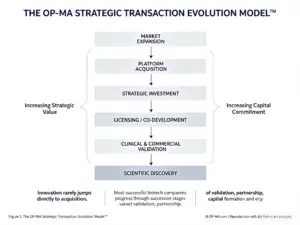
Figure 1 Caption: The OP-MA Three-Layer Transaction Model™ illustrates how successful acquisitions require simultaneous alignment across scientific, strategic, and capital dimensions. Weakness in any single layer compromises the entire transaction.
OP-MA Insight
“The most common mistake in biotech M&A is treating a transaction as purely financial. The most successful acquirers treat it as scientific, strategic, and financial—simultaneously.”
Part Two
The Strategic Optionality Framework
The most fundamental shift in biotech M&A is a change in what acquirers are buying.
The old model was straightforward: buy revenue. Acquire a company with existing products and growth to fill a pipeline gap.
The new model is fundamentally different: buy optionality. Acquire potential—platforms that can be applied across multiple indications, technologies that enable new modalities, relationships that provide access to future deal flow.
What Is Strategic Optionality?
Strategic optionality is the value of having choices. It is the right, but not the obligation, to pursue multiple future paths.
In biotech M&A, optionality manifests in several ways. Scientific optionality means acquiring a platform that can be applied across multiple indications—such as Lilly’s acquisition of BPL-003, which could treat treatment-resistant depression, anxiety, and other CNS disorders. Commercial optionality means gaining access to new geographies, channels, or customer segments—such as Angelini’s acquisition of Catalyst, which provided immediate U.S. market presence. Relationship optionality means partnerships that create future acquisition pathways, which is the essence of the “license-to-acquisition” model. Technological optionality means platforms that enable new modalities, from AI-driven discovery to gene editing to novel delivery systems.
Why Optionality Matters More Than Revenue
In an environment where the patent cliff is approaching rapidly—by 2032, an estimated $300 billion in drug sales will face generic erosion—and the cost of internal R&D continues to rise to $2.6 billion per new drug, the company that can acquire potential rather than just current performance has a significant advantage.
“Revenue is linear. Optionality is exponential.”
The OP-MA Strategic Optionality Framework
The framework identifies five pathways through which optionality is created and exercised. Research collaborations provide early-stage partnerships that give visibility into emerging science. Strategic licensing agreements test the science and the partner. Minority investments provide influence without full commitment. Co-development programs share risk and reward. And full acquisition is the final expression of the relationship.
The best acquirers build relationships at the first pathway, invest at the third, and acquire at the fifth.
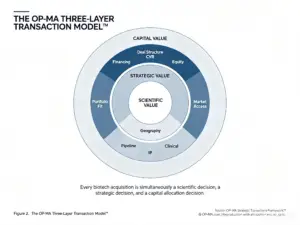
Figure 2 Caption: The OP-MA Strategic Optionality Framework™ shows how acquirers progressively build strategic options through five pathways. Each pathway increases visibility, reduces uncertainty, and creates the conditions for eventual acquisition.
OP-MA Insight
“The best acquirers do not wait to bid at the last stage. They build relationships at the first stage, invest at the third, and acquire at the fifth.”
Part Three
The Innovation Commercialization Ladder™
The Innovation Commercialization Ladder™ describes the five stages through which an innovation progresses from laboratory discovery to value-creating acquisition. Understanding this progression is essential for both acquirers seeking assets and companies seeking to position themselves for acquisition.
Stage One: Research
This is the birth of an idea—academic research, early-stage biotech, or platform technology. Scientific uncertainty is high, regulatory clarity is minimal, and value is speculative. Most acquirers cannot effectively evaluate assets at this stage. The relationship infrastructure built through academic partnerships and early-stage investing creates preferential access.
Stage Two: Clinical Validation
The asset demonstrates proof-of-concept in human trials. Phase 1/2 data becomes available and regulatory designations such as Fast Track or Breakthrough Therapy become possible. Development costs increase dramatically, and value becomes measurable. This is the stage where external partners become most valuable, providing both capital and regulatory expertise.
Stage Three: Commercial Validation
The asset demonstrates commercial potential. Phase 3 data is available or near completion, the regulatory pathway becomes clearer, and the market opportunity becomes assessable. The licensing phase serves as a de-risking period, allowing both parties to observe performance, assess cultural fit, and build trust. Most successful acquisitions in the current era emerge from prior licensing relationships.
Stage Four: Strategic Validation
The asset has been validated by a strategic partner. A partnership has been established with major pharma, and there is a shared development and commercialization path. Strategic investment provides a “call option” on the asset, generating deal flow visibility and creating a pathway to full acquisition.
Stage Five: Acquisition
The asset is fully acquired, typically at a premium. Full transfer of ownership occurs, and integration into the acquirer’s platform begins. The acquisition should be the conclusion of a relationship, not the beginning. The diligence, trust, and strategic alignment should have been built through previous stages.
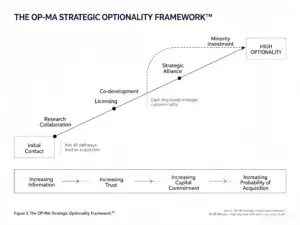
Figure 3 Caption: The OP-MA Innovation Commercialization Ladder illustrates the five stages through which a scientific innovation progresses. Each stage reduces uncertainty and increases value, creating the conditions for strategic partnership and eventual acquisition.
OP-MA Insight
“Acquiring at Stage Five is expensive. Building relationships at Stage Three is strategic.”
Part Four
Case Studies
The following case studies demonstrate the OP-MA Strategic Transactions Framework in action.
CASE STUDY A
Eli Lilly and the Bet on a Paradigm Shift
Eli Lilly agreed to acquire AtaiBeckley for $2.8 billion in cash, with contingent value rights (CVRs) potentially increasing total consideration to $3.8 billion. The lead asset is BPL-003, a Phase 3-ready 5-MeO-DMT nasal spray for treatment-resistant depression with Breakthrough Therapy Designation.
Applying the Three-Layer Model:
At the scientific layer, the acquisition secures a Phase 3-ready asset in a therapeutic area where innovation has been stagnant for decades. Lilly’s existing neuroscience capabilities can accelerate development and expand indications.
At the strategic layer, this acquisition is about optionality. AtaiBeckley had no approved products and minimal revenue. Lilly is not buying cash flow—it is buying a platform that could be applied across multiple neuropsychiatric indications.
At the capital layer, the use of CVRs demonstrates sophisticated risk-sharing. By structuring part of the consideration as milestone-based, Lilly transfers a portion of clinical development risk to the sellers while maintaining alignment.
OP-MA Insight: This transaction illustrates the optionality premium—the willingness to pay a significant price not for what the asset is worth today, but for the strategic choices it creates for tomorrow.
CASE STUDY B
Angelini Pharma and the Architecture of Scale
Angelini Pharma acquired Catalyst Pharmaceuticals for $4.1 billion in cash, simultaneously entering the U.S. market and acquiring a portfolio of commercial-stage rare disease products.
The transaction was financed through an innovative capital structure: Blackstone provided €1 billion in preferred equity, CDP Equity invested €1 billion for a 23.5% stake, and BNP Paribas led a syndicated loan for the remainder.
Applying the Three-Layer Model:
At the scientific layer, Angelini acquires two commercial-stage rare disease assets with established reimbursement pathways and a loyal prescriber base. The assets complement Angelini’s existing CNS expertise.
At the strategic layer, this acquisition creates commercial optionality. For the first time, Angelini has a U.S. commercial presence—a foundation that can be used to launch future products and establish a global rare disease platform.
At the capital layer, Angelini demonstrated that capital structure is a competitive advantage. By combining private equity, national strategic capital, and traditional bank financing, the company achieved a scale that would otherwise be impossible for a mid-sized European player.
OP-MA Insight: The participation of CDP Equity signals Italian national interest in building a global rare disease champion—a narrative that opens doors to future partnerships and regulatory support.
Part Five
Geography No Longer Defines Innovation
The traditional view of biotech innovation has been geographically concentrated. The assumption has been that the United States leads, Europe follows, and other regions are periphery.
This assumption is obsolete.
Innovation is becoming geographically decentralized while commercialization is becoming strategically centralized. China’s emergence as a source of high-quality, cost-effective pipelines is the most visible manifestation of this shift, but South Korea and Australia have also established themselves as credible hubs for translational research. Even Europe, long viewed as a follower, is producing assets that are increasingly competitive on a global stage.
The implication for deal-makers is clear. Acquirers that restrict their search to traditional geographies will pay a premium for assets while missing the most interesting opportunities. The highest-return investments increasingly come from non-traditional hubs.
“Innovation is becoming geographically decentralized, while commercialization is becoming strategically centralized.”
OP-MA Insight
“The companies that win the next decade will be those that source innovation globally while commercializing it centrally.”
Part Six
Key Industry Trends
The following trends provide context for the OP-MA Strategic Transactions Framework. They are not predictions—they are descriptions of patterns that are already visible in the market.
The License-to-Acquisition Path Is Becoming Standard
In 2026, over 60% of biotech acquisitions originated from prior licensing or collaboration relationships. The logic is compelling: licensing provides a de-risking period, allows both parties to observe performance and assess cultural fit, and enables future acquisition terms to be structured upfront. Companies that are not engaged in licensing relationships are not building the optionality that leads to acquisition.
Contingent Structures Are Becoming Mainstream
The Lilly-AtaiBeckley CVR structure is not an exception—it is a leading indicator. CVRs, milestone payments, and other contingent instruments bridge valuation gaps, align incentives around long-term success, share development risk with sellers, and allow buyers to pay for success rather than just potential. Deal architects who understand contingent instruments have a significant competitive advantage.
Capital Structure Is Becoming a Strategic Advantage
The Angelini-Catalyst transaction demonstrates that the ability to assemble a coalition of capital can transform what is possible. Acquirers are increasingly partnering with private equity for flexible capital, engaging sovereign funds for long-term support, and using strategic investors to signal credibility. The company with the best capital structure, not necessarily the largest balance sheet, will win the best deals.
OP-MA Insight
“The most sophisticated acquirers are not the ones with the largest balance sheets. They are the ones with the most creative capital structures.”
Part Seven
Looking Ahead
Based on the Strategic Transactions Framework, the next decade of biotech M&A will be shaped by patterns that are already visible today. The following observations are not speculative—they are extensions of trends that are already in motion.
License-first will become the default path. The proportion of acquisitions originating from prior licensing relationships will exceed 75% by 2030. Licensing will no longer be an alternative to acquisition—it will be the standard precursor.
CVRs and contingent structures will become standard. Contingent value rights and similar instruments will become a standard part of deal architecture, not an exception. Valuation gaps will be routinely bridged with milestone-based payments.
Minority investments will increase. Strategic minority investments will increase significantly as companies seek “call options” on future acquisitions without committing to full purchase.
China-originated innovation will continue to rise. China’s share of global biotech licensing deals will continue to increase, driven by scientific capability, cost efficiency, and a maturing regulatory environment.
Capital structure will become more important than valuation. The ability to assemble creative capital structures will increasingly determine which companies win competitive auctions. The highest bid will not always be the largest check—it will be the most reliable, most flexible, and most strategically aligned capital.
Deal architects will emerge as a distinct role. The role of “deal architect”—someone who designs transaction structures rather than just negotiates terms—will become a recognized function in business development organizations.
The relationship economy will overtake the auction economy. The most attractive deals will increasingly be negotiated through existing relationships rather than competitive auctions. Companies that invest in relationship building will achieve better terms, lower premiums, and earlier access to opportunities.
OP-MA Insight
“The next decade will not belong to companies that can pay the most. It will belong to companies that can think the most creatively about how transactions should be structured.”
Part Eight
What Leaders Should Remember
Great acquisitions are simply the final expression of years of strategic positioning—the visible tip of an iceberg built from scientific diligence, capital architecture, and relationship engineering.
In an era defined by patent cliffs, rising development costs, geographically distributed innovation, and intense competition for high-quality assets, the company that masters deal architecture will have a decisive advantage over the company that merely has a large balance sheet.
“Companies rarely fail because they lack innovation. They fail because they misunderstand how innovation becomes transactions.”
The future belongs not to companies that discover science alone, but to those that understand the architecture of strategic deals.
About OP-MA
OP-MA publishes independent research on global biotechnology transactions, cross-border licensing, strategic partnerships, and healthcare investment.
The OP-MA Strategic Transactions Series explores the long-term principles behind successful biotech deal-making.
Forthcoming papers in the series include Why Licensing Is Becoming the New Acquisition, Capital Structure as Competitive Advantage, The Relationship Economy of Cross-Border Healthcare Transactions, Building Companies That Buyers Want to Acquire, The Role of AI in Transaction Architecture, The Rise of National Champions in Global Biotech, and The China Factor: Innovation, Capital, and Deal Flow.
Copyright © 2026 NXA Technologies (Zhuhai) Co., Ltd.